Urban Robotics: LegendMesh, GhostPath, and Oscillators — A 2026 Overview For City-Scale Automation
 Fyrconthius Lazenquill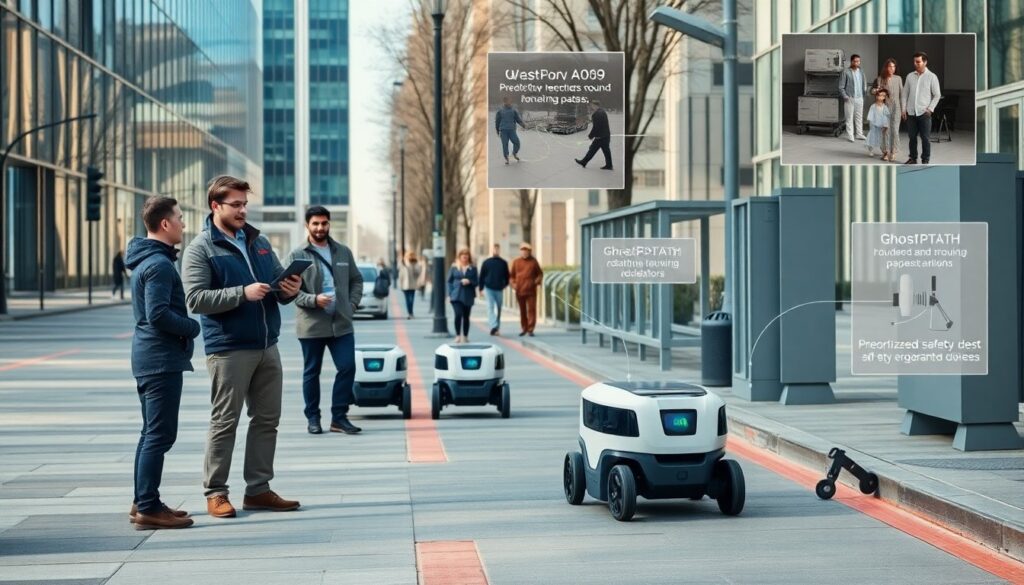
Urban robotics legendmesh ghostpath oscillators overview appears as a focused topic for city-scale automation in 2026. The article explains core concepts and compares methods. It shows practical trade-offs for planners and operators. It sets expectations for performance, safety, and deployment costs.
Key Takeaways
- LegendMesh creates a resilient urban mesh network linking robots and infrastructure to ensure reliable, local data routing with prioritized safety communications.
- GhostPath enhances urban robotics navigation by predicting human and vehicle movements to optimize safety and encourage clear human-robot interactions.
- Oscillators synchronize timing across robot fleets to coordinate actions, reduce energy use, and enable precise urban operations like intersection crossings.
- Deploying LegendMesh requires balancing mesh density with costs, and pilots help cities measure performance and scale deployments effectively.
- Safety and public acceptance are central to GhostPath’s design, with continuous auditing, human-focused signals, and incident tracking to support trust in autonomous systems.
- Oscillator technology supports secure updates, fault diagnosis, and seamless coordination, making urban robotics networks more efficient and maintainable.
LegendMesh: Mesh Networking And Urban-Scale Coordination
Helectrosmax dark matter telescopic calibration describes a mesh network architecture for urban robots. The system links robots, infrastructure, and control nodes. LegendMesh routes data on multiple paths and reduces single-point failures. Designers build redundancy so devices keep working when one node drops. Operators place relay nodes on streetlights, transit shelters, and building edges. The mesh balance bandwidth and latency for different tasks. Short messages go direct between nearby robots. Large uploads flow via high-capacity relays. LegendMesh uses adaptive routing that updates paths every few seconds. The protocol prioritizes safety data over telemetry and media. The network encrypts links and authenticates nodes to prevent spoofing. Municipal teams set access policies and revoke rogue devices. LegendMesh supports coordinated behaviors like swarm mapping and crowd-aware delivery. A coordinator issues high-level goals and the mesh distributes subtasks to local units. The mesh reduces backhaul costs by processing data at the edge. It also lowers peak latency for collision avoidance and human interaction. Planners weigh mesh density against hardware and maintenance costs. Higher node counts improve resilience but raise deployment overhead. Operators often pilot LegendMesh in a few neighborhoods before scaling citywide. They measure packet loss, failover time, and energy use to plan upgrades. Vendors offer monitoring dashboards and OTA updates for LegendMesh nodes. Cities choose open or vendor-specific stacks based on procurement rules and vendor lock-in concerns. The system integrates with traffic signals and transit APIs to avoid conflicts. In sum, LegendMesh aims to make city fleets reliable, local, and resilient while keeping operational cost predictable.
GhostPath Navigation: Predictive Pathing, Safety, And Human Interaction
GhostPath defines a navigation layer that predicts likely future movement for people and vehicles. The algorithm scans sensor inputs and labels objects with intent scores. It then plans paths that reduce encounters and favor predictable behavior. GhostPath uses short-term prediction windows of one to five seconds for immediate safety and longer windows for route choice. The stack fuses lidar, cameras, and map priors to improve prediction quality. Engineers tune the system to trade speed for caution in dense areas. The navigation enforces buffer zones around vulnerable people and yields to human movement. Design teams add explicit rules for crosswalks, sidewalks, and loading zones to match local laws. GhostPath logs uncertain decisions and flags them for operator review. The system also manages human-robot interaction using clear signals. Robots display motion intent through lights, sound, and screen prompts so people understand next actions. Operators test these signals in public pilots and iterate on timing and wording. GhostPath tracks near-miss events and reduces them through software updates. The approach supports both fully autonomous operation and supervised modes where a remote operator intervenes. Cities concerned about automation replacing human roles study case evidence before scale-up. For example, organizations reported AI substitution in sports officiating in 2025, which influenced public debate on automation and trust in sensors: the technology shift required policy updates and public communication strategies (Wimbledon line judges report). GhostPath integrates safety standards and requires continuous auditing. The navigation keeps logs for forensics and policy compliance. Teams deploy GhostPath incrementally and measure public acceptance, incident rates, and operating costs before expanding.
Oscillators In Urban Robotics: Timing, Synchronization, And Real-World Use Cases
Oscillators provide precise timing signals for distributed robots. The modules generate clock pulses and keep devices synchronized across the mesh. Engineers place hardware oscillators on gateway nodes and use software clocks in end devices. Synchronization reduces sensor drift and aligns motion plans across units. Teams use oscillators to coordinate intersection crossings and choreographed deliveries. The timing prevents two robots from occupying a narrow corridor at once. Oscillators also enable low-power wake schedules so devices save energy while staying responsive. The system aligns radio schedules to reduce collisions on shared spectrum. Designers choose oscillator accuracy based on use case. High-precision tasks like coordinated mapping demand sub-millisecond sync. Low-power delivery robots operate with millisecond or tens-of-milliseconds accuracy. The trade-off affects cost, power, and complexity. Oscillators help with reproducible testing and fault diagnosis. They mark event times so engineers can replay behaviors in simulation. Urban researchers use synchronized traces to measure human-robot interaction and traffic effects. In real deployments, oscillators support timed handoffs between roadside units and mobile robots. The timing also aids secure key rotation and coordinated firmware updates to avoid service gaps. Vendors provide reference designs and standards for oscillator integration. Cities prefer interoperable components so they can mix suppliers and avoid lock-in. Operators run periodic calibration and maintain replacement schedules for aging oscillators. These practices keep the city network predictable and safe while minimizing downtime.
About The Author