Rocket League Rank Distribution 2026: Where Do You Stand Among Players?
 Fyrconthius Lazenquill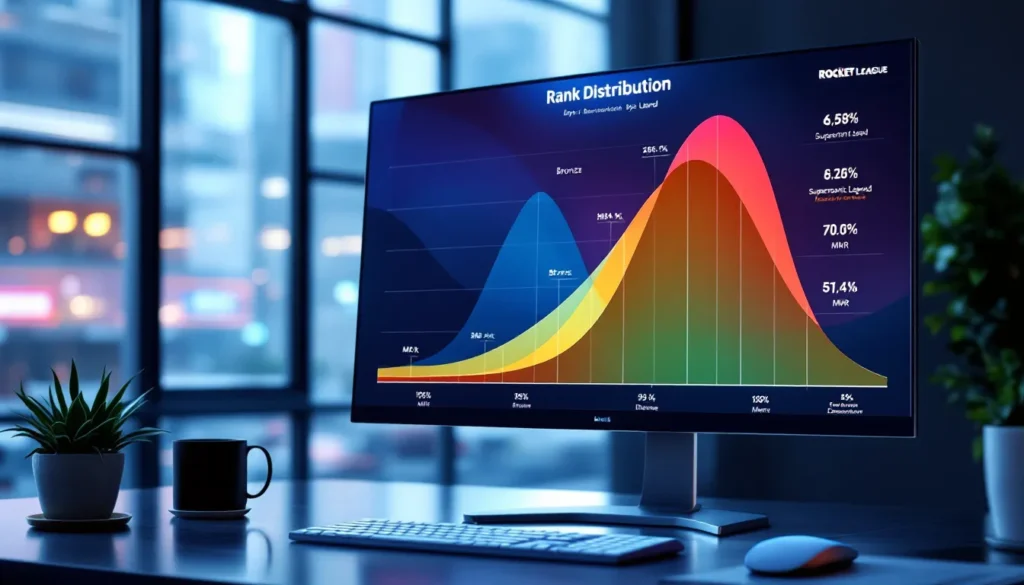
You’ve just finished a session of Rocket League, and you’re sitting at Gold III. You’re wondering: is that good? Are you average, or have you climbed above the pack? Understanding where you fit in the rocket league rank distribution isn’t just about bragging rights, it’s about setting realistic goals and knowing what it takes to push into the next tier.
The Rocket League ranking system places millions of players across a wide spectrum, from Bronze to the elusive Supersonic Legend. Each rank represents not just skill, but consistency, game sense, and mechanical ability. But here’s the thing: rank distribution isn’t static. It shifts with every season, every reset, and every balance tweak Psyonix implements.
In this guide, we’ll break down the current rocket league rankings for 2026, explore how MMR (Matchmaking Rating) works behind the scenes, compare distribution across different playlists, and give you the tools to understand exactly where you stand, and how to climb higher.
Key Takeaways
- Rocket League rank distribution follows a bell curve centered on Gold and Platinum, with roughly 49% of players occupying these middle ranks where climbing requires focused improvement on specific weaknesses rather than broad skill gains.
- Understanding your percentile standing is more valuable than your rank badge alone—being Platinum III means you’re better than two-thirds of all competitive players, while Diamond III places you in the top 15%.
- MMR (Matchmaking Rating) is the hidden numerical system behind your visible rank, and thresholds shift between seasons, making your percentile standing a more stable measure of skill than the rank badge itself.
- Different playlists have significantly different rank distributions: 1v1 Duels heavily weight lower ranks because there’s no teammate to cover mistakes, while Standard has the smoothest distribution due to team compensation.
- Climbing from Diamond to Champion requires executing everything you know at tournament speed with minimal errors, as this represents one of the steepest jumps in the rocket league ranking system.
- Your rank distribution context directly informs training priorities—Gold players need consistency, Platinum players need speed, Diamond players need game sense, and Champion+ players need marginal refinement in decision-making and recoveries.
Understanding Rocket League’s Ranking System
How Rocket League Ranks Work
The rocket league ranking system is divided into tiers that represent your competitive skill level. Here’s the complete hierarchy of all rocket league ranks in order:
- Bronze I–III
- Silver I–III
- Gold I–III
- Platinum I–III
- Diamond I–III
- Champion I–III
- Grand Champion I–III
- Supersonic Legend
Each rank is further split into rocket league divisions (Division I through IV), creating granular progression steps within each tier. When you win matches, you gain MMR, and your division advances. Win enough, and you’ll rank up to the next tier. Lose too many, and you’ll derank.
What’s important here is that your rocket league rank isn’t just a badge, it’s a direct reflection of your MMR bracket. The system is designed to match you with players of similar skill, ensuring competitive balance. But unlike some games, Rocket League doesn’t hide your rank behind vague labels. You know exactly where you stand.
MMR Explained: The Hidden Number Behind Your Rank
Rocket league mmr ranks are the numerical foundation of the entire system. While you see “Gold II Division III” on your screen, behind the scenes, the game tracks a precise MMR value, something like 612 or 1247.
Here’s how it works: every ranked match adjusts your MMR based on the outcome and the relative skill of your opponents. Beat a higher-ranked team? You gain more MMR. Lose to a lower-ranked squad? You lose more. The system uses a modified Elo formula, similar to chess, but tuned for team-based play.
MMR thresholds determine your visible rank. For example:
- Gold I might start at 515 MMR
- Platinum I begins around 635 MMR
- Diamond I kicks off near 855 MMR
- Champion I starts at approximately 1075 MMR
These thresholds can shift slightly between seasons as Psyonix adjusts the distribution curve. Your visible rank is simply a label for your current MMR range, while divisions mark your progress within that range. Understanding this helps explain why sometimes a single win vaults you into the next division, while other times you need several wins to break through.
Complete Rocket League Rank Distribution Breakdown
Current Season Rank Percentages
As of the 2026 competitive season, the rank distribution rocket league data shows a bell curve centered around Gold and Platinum. Here’s the current breakdown for 3v3 Standard (the most populated playlist):
- Bronze: ~5%
- Silver: ~15%
- Gold: ~26%
- Platinum: ~23%
- Diamond: ~18%
- Champion: ~10%
- Grand Champion: ~2.5%
- Supersonic Legend: ~0.5%
This distribution reflects Psyonix’s intentional design philosophy: most players cluster in the middle ranks, with progressively fewer players at the extremes. The system creates a healthy competitive ecosystem where climbing feels meaningful but achievable.
Bronze Through Silver: The Starting Ranks
Bronze and Silver represent the entry point for most new players. If you’re here, you’re learning the basics: hitting the ball consistently, understanding rotations, and getting comfortable with boost management.
Bronze players (bottom ~5%) are often still mastering camera settings and basic aerial control. Ball-chasing is common, and positioning concepts haven’t clicked yet. It’s not a criticism, everyone starts somewhere.
Silver players (roughly 15-20% cumulative) show improvement in ball contact and basic rotation. They’re starting to anticipate where the ball will go rather than constantly reacting. But, aerial play remains inconsistent, and defensive positioning is often too aggressive.
Both ranks are highly volatile. New players can climb out rapidly with focused practice, while inactive accounts or smurfs can skew the data slightly.
Gold and Platinum: The Middle Majority
This is where nearly half of all competitive players reside. Gold (~26%) and Platinum (~23%) represent competency without mastery.
Gold players have solid fundamentals. They can aerial for simple shots, rotate with purpose (most of the time), and understand boost starvation tactics. But, their mechanics lack consistency. They’ll nail a ceiling shot in training, then whiff an open net in-game.
Platinum players refine these skills. Their aerials are more reliable, they’re faster to challenges, and they’re beginning to read opponent patterns. The gap between Plat I and Plat III is significant, high Plat players often have mechanics that rival low Diamond, but their decision-making or speed holds them back.
If you’re Gold or Plat, you’re solidly average. Not an insult, average in a game with millions of players means you’ve developed real skill. The climb from here requires addressing specific weaknesses rather than broad improvement.
Diamond and Champion: Above Average Territory
Breaking into Diamond puts you in the top 30% of players. This is where the game shifts from “knowing what to do” to “doing it quickly and consistently.”
Diamond players (~18%) have strong mechanical foundations. They’re comfortable with fast aerials, half-flips, and power shots. Their rotation is usually sound, though they sometimes hesitate or double-commit under pressure. Speed becomes the differentiator, Diamond players make the right play, but Champions make it faster.
Champion ranks (~10%) represent the upper echelon of regular competitive play. These players read the game two touches ahead, their recoveries are lightning-fast, and they punish mistakes ruthlessly. According to competitive gaming analytics, Champion players demonstrate significantly higher consistency metrics in both offensive pressure and defensive saves compared to Diamond.
The jump from Diamond III to Champion I is one of the steepest in the game. It’s not about learning new mechanics, it’s about executing everything you know at tournament speed, under pressure, with minimal errors.
Grand Champion and Supersonic Legend: The Elite
Grand Champion (GC) sits at roughly 2.5% of the player base. These are players who have near-professional mechanics and game sense. They’re not just fast, they’re efficient, wasting zero boost or positioning.
GC players can execute advanced techniques like flip resets, ceiling shuffles, and double taps with consistency. More importantly, they know when to use them and when a simple power clear is the right play.
Supersonic Legend (SSL), the pinnacle rank introduced in Season 1 of Free-to-Play, represents the top 0.5% (roughly 0.02% at the very top). These are RLCS-adjacent players, content creators, and grinders with thousands of hours. The gap between low SSL and top 100 SSL is wider than Bronze to Champion.
Reaching SSL means you’re not just playing Rocket League, you’re performing it at a level where every touch has purpose, every rotation is optimized, and mechanical execution is essentially flawless.
Rank Distribution Differences Across Playlists
1v1 Duel Distribution
Duels present the harshest distribution curve. Most players rank 1-2 tiers lower in 1v1 compared to their 3v3 rank. Why? There’s no teammate to cover your mistakes.
The 1v1 rank distribution is heavily weighted toward lower ranks:
- ~40% of players sit in Gold or below
- Platinum represents about 25%
- Diamond and above account for roughly 20%
1v1 punishes mechanical mistakes and poor boost management instantly. A whiff doesn’t just give up possession, it often means a goal. This playlist attracts fewer casual players, so the competition density is higher at every tier.
2v2 Doubles Distribution
Doubles is the most popular competitive playlist, and its distribution closely mirrors 3v3 Standard with slight variations:
- Slightly fewer Bronze/Silver players (~18% combined)
- Gold and Platinum remain the bulk (~48%)
- Champion and above sit around 12%
Doubles demand faster rotations than 3v3 but allow more individual playmaking than 1v1. It’s the sweet spot for many players, which inflates the middle ranks slightly. Recent esports community analysis of pro player ranking trends shows that many RLCS competitors maintain SSL across both Doubles and Standard, but the path to SSL is considered slightly harder in Doubles due to carry potential being lower.
3v3 Standard Distribution
As mentioned earlier, Standard has the smoothest bell curve. It’s the most forgiving playlist because three players can compensate for individual errors. This leads to:
- Fewer players stuck in Bronze/Silver (~20%)
- The largest Gold/Plat population (~49%)
- A stable high-rank population (~12% Champion+)
Standard is where most players establish their “true” rank because team play smooths out mechanical inconsistencies. Your positioning and rotation matter more than flashy mechanics.
Extra Modes Ranking Trends
Extra modes (Rumble, Hoops, Dropshot, Snow Day) have wildly different distributions. Because they attract smaller, more casual populations, ranks are inflated.
A Gold player in Standard might hit Diamond in Rumble simply because fewer serious players queue there. The rocket league competitive ranks in Extra Modes are less meaningful as skill indicators, but they’re fun progression systems for players who want variety without the stress of standard competitive.
Hoops, in particular, skews toward players with strong aerial control, creating a slight skill compression in higher ranks.
How Rocket League’s Rank Distribution Has Changed Over Time
Historical Rank Shifts Since 2015
When Rocket League launched in 2015, the ranking system was rough. The original 12-rank system (Prospect through Champion) created uneven distribution, with most players trapped in Challenger and Rising Star.
In Season 3 (2016), Psyonix introduced Grand Champion tiers and adjusted MMR curves, spreading the player base more evenly. This was the first major rank inflation correction.
The biggest shift came with the Free-to-Play update in September 2020. The player base exploded, and Psyonix added Supersonic Legend as a new top rank. They also recalibrated MMR thresholds, which temporarily deflated ranks by 1-2 tiers for many players. A Diamond II player might suddenly find themselves in Platinum I.
Since then, distribution has stabilized. Psyonix occasionally tweaks thresholds between seasons, but the overall shape, a bell curve centered on Gold/Plat, has remained consistent.
Recent Season Adjustments and Resets
Every season brings a soft MMR reset. Your rank doesn’t fully reset, but it gets adjusted slightly toward the middle. If you ended last season at Champion II, you might place at Champion I after your placement matches.
Season 12 (early 2024) saw notable compression at the top end. SSL MMR requirements increased by roughly 50 points, making the top rank more exclusive. This was in response to rank inflation from the growing player base.
Season 14 (current as of March 2026) maintained these adjustments with minor tweaks. Psyonix has stated their goal is to keep Grand Champion at approximately 2-3% of the player base and SSL under 0.5%. Based on gaming news coverage of recent Rocket League updates, these distribution targets have remained consistent across the past several seasons.
The takeaway? Your rank from three years ago isn’t directly comparable to today. The system evolves, but your percentile standing is a more stable measure of skill than the rank badge itself.
What Your Rank Really Means: Percentile Analysis
Let’s translate rocket league ranks in order into percentile context. This helps you understand not just “Am I Gold?” but “What does Gold mean?”
Here’s the percentile breakdown based on current 3v3 Standard distribution:
- Bronze III: Bottom 5% (you’re learning fundamentals)
- Silver III: ~20th percentile (you’ve got the basics down)
- Gold III: ~45th percentile (you’re approaching average)
- Platinum III: ~68th percentile (you’re above average)
- Diamond III: ~85th percentile (you’re in the top 15%)
- Champion III: ~97th percentile (you’re in the top 3%)
- Grand Champion I: ~98.5th percentile (elite territory)
- Supersonic Legend: ~99.5th percentile (you’re in conversation with pros)
These percentiles reframe achievement. Being Platinum III doesn’t sound flashy, but you’re better than two-thirds of all competitive players. Diamond III? You’re outperforming 85% of the player base.
Conversely, if you’re Bronze, you’re not “bad”, you’re new or still learning. The system is designed to place you where you can have competitive matches. There’s no shame in any rank if you’re improving.
Percentile also explains why climbing gets harder. Moving from Platinum I to Platinum II might take 20 wins. Moving from Champion II to Champion III could take 50+ because you’re competing against progressively more skilled opponents for increasingly scarce rank slots.
How to Improve Your Rank and Climb the Distribution
Training Routines for Each Rank Tier
Bronze to Gold: Focus on consistency, not flashy plays. Spend 15 minutes daily in free play just hitting the ball hard and accurately. Practice the “Rookie Striker” and “Pro Aerial” training packs. Work on half-flips and fast aerials in custom training.
Gold to Platinum: Add speed. Run “Wall Shots” and “Redirects” training packs. Start incorporating power shots and backboard clears. Watch your replays and identify positioning mistakes, you’re likely too slow to rotate or too far from the play.
Platinum to Diamond: This is where mechanics meet game sense. Use workshop maps like “Speed Jump Boost” and “Dribbling Challenge #2” (PC). For console players, focus on aerial car control in “Aerial Off-Wall” packs. Start shadowing opponents instead of challenging every ball.
Diamond to Champion: Refine decision-making. Run “Ultimate Warm-Up” by Poquito before every session. Practice flip resets and ceiling shots, but more importantly, learn when NOT to use them. Review your replays with a critical eye: are you challenging too early? Rotating too far post?
Champion to GC+: At this level, marginal gains matter. Work on recoveries, boost-starving opponents, and pre-jump reads. Consider hiring a coach or joining a competitive team to get high-level feedback. Your mechanics are probably fine, your speed and consistency need polish.
Common Mistakes Holding Players Back
Ball-chasing is the #1 killer in Gold and below. If you’re constantly rushing the ball, you’re out of position when it gets cleared. Trust your teammates. Rotate back post.
Poor boost management plagues Plat through Diamond. You don’t need 100 boost for every play. Learn to play on 30-40 boost and grab small pads. This keeps you in the play instead of drifting to corners for big boost.
Over-committing on defense loses games in Diamond and Champion. If you challenge and miss, your teammate is now in a 1v2 or 1v3. Sometimes the right play is to shadow, forcing opponents to make the first mistake.
Mechanical showboating is tempting in Champion+. Yes, you can hit a flip reset. But was it the right play? A simple power shot or pass is often more effective. Style is earned after consistency.
Ignoring positioning is the hidden bottleneck at every rank. You can drill mechanics for hours, but if you’re in the wrong place when the ball comes, it doesn’t matter. Watch RLCS VODs not for the flashy goals, but for player positioning during transitions.
Why Rank Distribution Matters for Competitive Play
Understanding rocket league rank distribution isn’t just trivia, it’s strategic.
First, it sets realistic expectations. If you’re Gold II, you’re not “stuck” or “hardstuck”, you’re literally in the middle of the player base. Climbing to Platinum is achievable with focused practice, but expecting to jump to Champion in a month is unrealistic unless you’re dedicating serious hours.
Second, it informs matchmaking decisions. Knowing that 1v1 ranks are deflated helps explain why your Duels rank is lower than your Standard rank. It’s not that you’re worse, it’s that the distribution curve is harsher.
Third, distribution data helps you find your peer group. If you’re Diamond III, you’re in the top 15%. That’s the audience for advanced training packs and coaching content. You’re past beginner guides but not quite ready for RLCS-level analysis.
For competitive teams and tournaments, distribution matters for seeding and balance. Tournament organizers often use MMR cutoffs (not visible ranks) to create fair brackets. Understanding where you sit in the distribution helps you target appropriate competitive events.
Finally, distribution shifts with meta changes. If Psyonix nerfs flicks or buffs demos, certain playstyles become more effective, which can shift rank distribution slightly. Staying aware of these trends gives you an edge.
The rocket league levels of skill are more nuanced than simple rank labels suggest. Distribution context turns “I’m Plat” into “I’m better than 60% of players but need to improve X and Y to reach Diamond.”
Conclusion
Rank distribution in Rocket League is more than a leaderboard, it’s a skill map. Whether you’re grinding your way out of Gold, pushing for Champion, or eyeing that elusive Supersonic Legend, knowing where you stand in the broader player base gives you perspective.
The system is designed to place you where you belong, and climbing requires deliberate improvement, not just grinding games. Focus on the specific weaknesses of your tier, study the percentiles to set realistic goals, and remember that every rank represents genuine progress.
Your rank isn’t who you are, it’s where you are right now. And the beauty of Rocket League is that with the right practice, you can always move up. Now get back in the arena and prove where you belong.
About The Author